If your business serves customers in Saudi Arabia, Qatar or anywhere in the Arab region, an English-only website loses a large part of its audience before it even starts. Arabic is the language your customers search in, read in and trust. But a poor Arabic version can hurt you more than having none at all.
This article is part of the Arabic Localization & RTL section. It covers what proper localization really means, and the signs that your Arabic version needs a review.
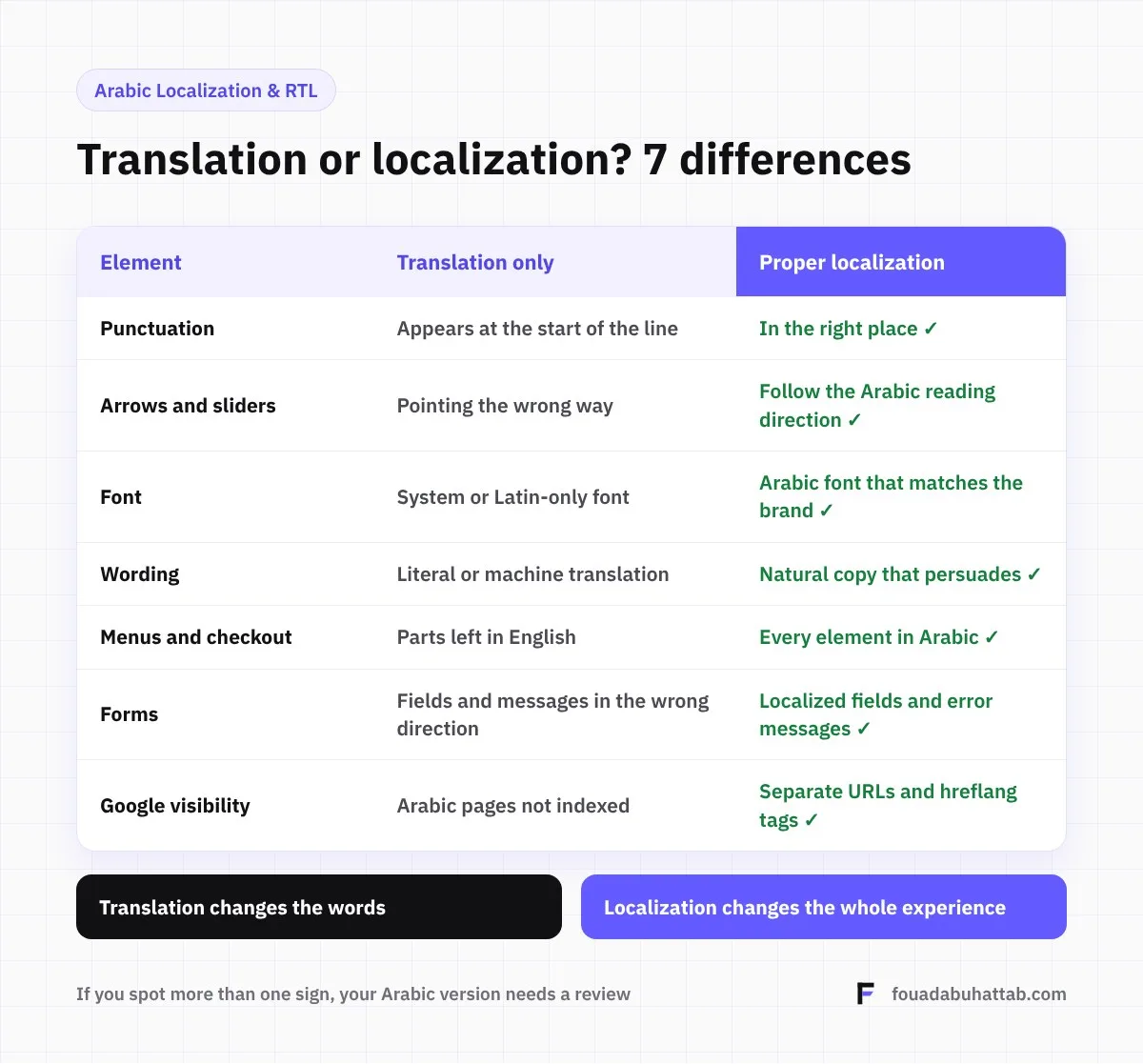
In short: translation changes the words, while localization changes the whole experience: page direction, fonts, numbers, forms and visibility in Arabic search results.
Why an Arabic version matters for your business
Most of your Arabic-speaking visitors will choose the Arabic version when it exists, especially for financial decisions like buying or requesting a quote. An Arabic version also opens a second front in search: specialized Arabic content is far scarcer than English in most industries, so ranking for Arabic keywords is easier and faster.
RTL is more than translation
Arabic reads right to left, and that changes everything on the page: the layout mirrors, menus move to the opposite side, and arrows and icons change direction. This is where most websites fail. They translate the words but keep a left-to-right design, producing mixed-direction text and misplaced elements, which is the first thing that makes a visitor lose trust.
7 signs your Arabic version needs a review
1. Punctuation in the wrong place: a period or question mark appearing at the start of a line instead of the end.
2. Flipped arrows: a "next" button pointing the wrong way for an Arabic reader, or slider arrows on the wrong side.
3. Weak Arabic font: a default system font or a Latin font without proper Arabic glyphs, so the text clashes with the brand.
4. Literal translation: phrases that are obviously machine-translated, signaling that Arabic speakers are an afterthought.
5. Parts left in English: the menu, footer, form messages or the checkout page.
6. Broken forms: phone and email fields in the wrong direction, or error messages in English.
7. The Arabic version does not show up on Google: because it has no separate URLs, no hreflang tags, or untranslated SEO titles.
What proper WordPress localization includes
A fully mirrored RTL layout: that keeps the original design, not a distorted copy of it.
A professional Arabic font: such as IBM Plex Sans Arabic, Tajawal or Cairo, with sizes and line spacing adjusted, because Arabic letters need more vertical space than Latin ones.
Numbers, currencies and dates: correct Saudi and Qatari riyal formatting, and phone numbers that display properly inside Arabic text.
Every part of the site translated: pages, menus, footer, form messages and the emails customers receive.
Separate SEO for each language: independent URLs, titles and descriptions written for Arabic searchers, and hreflang tags that tell Google which version to show each visitor.
Is your Arabic version working as it should? Send me your website link and I will check it against the seven signs above and tell you what needs fixing. Request an Arabic version review
WooCommerce stores need it most
For stores, localization extends to product pages, the cart, checkout, order emails and invoices. A customer who browses products in Arabic and then hits an English-only checkout often stops right at that moment. If you are still choosing a platform, the comparison of WooCommerce vs Salla vs Zid will help.
Real bilingual builds
I have built bilingual Arabic and English WordPress websites with full RTL support for Ajnad Logistics and MICA International Commercial, both serving audiences across the region in both languages.
Frequently asked questions
Should I start with Arabic or English?
If most of your customers are in Saudi Arabia, start with Arabic. If your audience is mixed, as in Qatar, it is better to launch both languages together from day one.
Is machine translation enough?
It can be a starting point for a draft, but key pages such as services and products need a human review in proper Arabic that suits Gulf customers.
Do I need a new theme?
Usually not. Most modern themes can be localized and adjusted to fully support RTL without rebuilding the site.
Ready to speak your customers' language?
Explore my Arabic localization and RTL service, or get in touch and I will tell you exactly what your site needs for a proper Arabic version.