Many store owners believe sales growth is only about advertising. But ads bring visitors, while what turns them into buyers is the store itself: how customers pay, what shipping costs, how fast pages load, and how much they trust every step.
In this article I share seven technical decisions I made over three years of developing SmartBody, a supplements store in Riyadh whose monthly revenue grew from around 3,000 SAR to over 300,000 SAR. These decisions are not specific to supplement stores. They apply to any WooCommerce store targeting Gulf customers.
Results at a glance: 100x growth in monthly revenue, over 2.5 million SAR in the peak campaign month, and three years of continuous growth. Read the full case study
Decision 1: Don't force customers into a single payment method
Customers in Saudi Arabia and the Gulf do not all pay the same way. Some prefer cards, and a large segment relies on buy-now-pay-later and installments. If a customer reaches checkout and cannot find their preferred method, the result is usually an abandoned cart.
That is why I integrated three payment gateways together: Tap for cards, and Tamara and Tabby for buy-now-pay-later. It may look like extra complexity, but in reality it removes the biggest obstacle before an order is completed.
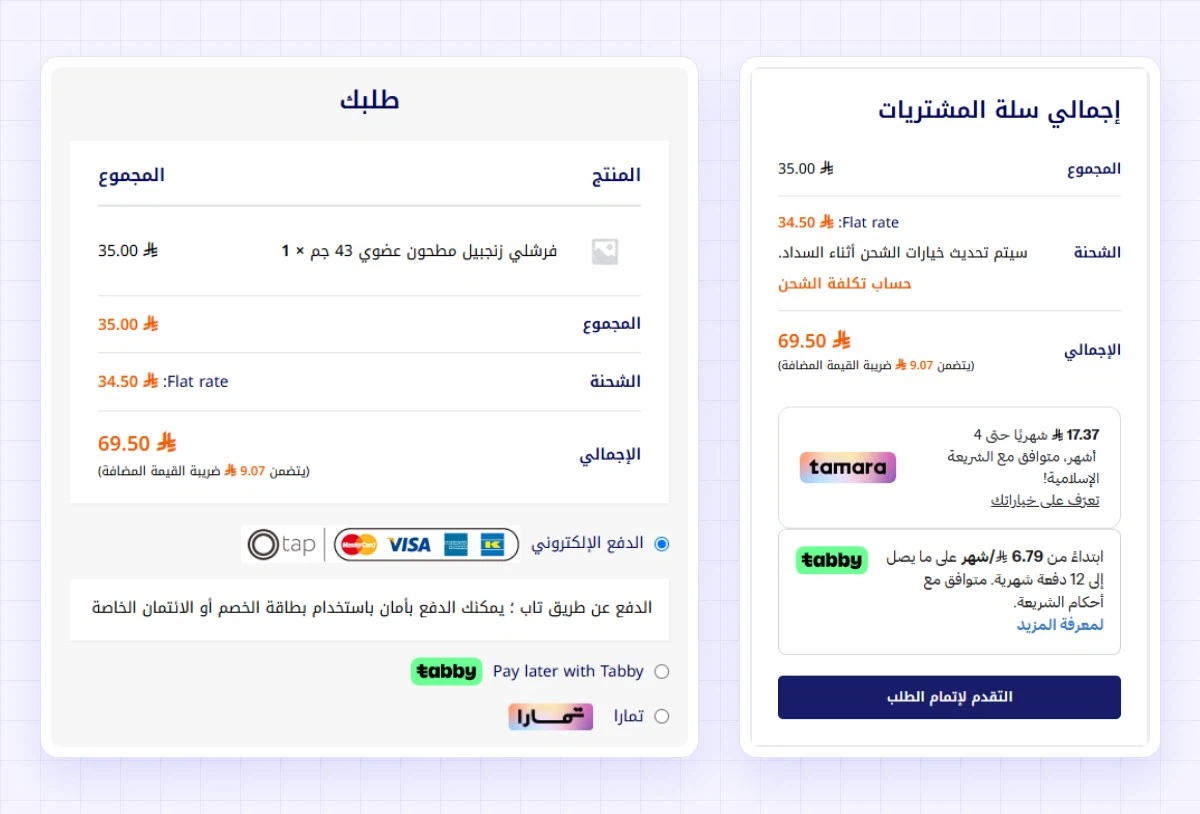
What you should do: Review your abandoned cart reports. If many of them stop at the payment page, the problem is usually the payment options, not the product.
If you are still choosing the right platform for your store, read my comparison of WooCommerce vs Salla vs Zid.
Decision 2: Make shipping costs fair and clear
Unexpected shipping costs are one of the most common reasons for abandoning an order. The solution is not necessarily removing shipping fees, but logical pricing the customer understands.
I built a pricing structure combining weight tiers (a flat rate up to 10 kg, then different rates above it) with region-based pricing across the Kingdom, with SMSA handling the actual delivery. Customers pay a cost that reflects their real order, and the store does not lose money on heavy orders.
What you should do: Do not use one flat rate for all orders if your products vary in weight. It either drives away customers with small orders or drains your margins on large ones.
Decision 3: Set up currency and tax before any design work
Details like the Saudi Riyal symbol, price display format and WooCommerce tax settings look minor, but they are the first thing a Gulf customer notices. Any error sends one message: this store is not professional.
That is why configuring currency formatting and tax settings for the Saudi market was part of the foundation, not a later improvement.
Is your store ready to grow? I review the payment, shipping and performance setup of your store and identify the obstacles that are costing you real sales. Request a store review
Decision 4: Recover what you would otherwise lose
Not every visitor who leaves the cart is a lost customer. Many simply got busy and need a reminder at the right time.
I set up abandoned cart recovery emails for the store, designing their content and timing myself. Alongside them, I built an automatic review request system that emails customers a few days after they receive their order. Genuine reviews then build trust with new visitors, turning into a lasting sales tool.
Decision 5: Structure categories for both buyers and search engines
Overlapping categories confuse customers and dilute the site's strength on Google. So I restructured the product categories, merged overlapping ones, ordered them by best sellers, and set their priorities together with the team's SEO specialist.
The result works both ways: customers reach products in fewer steps, and search engines understand the store's structure more clearly.
What you should do: If you have two categories showing nearly the same products, merge them. One strong category beats three weak ones. And if your store is also slow, start with WordPress speed optimization before any SEO work.
Decision 6: Build trust from inside your operations
In supplement and food stores, expiry dates are a matter of trust that leaves no room for error. The challenge is that each flavor or size is sold as a separate variation, often from a different production batch.
That is why I set up expiry tracking at the variation level, not for the product as a whole. This makes it possible to spot a batch nearing expiry in one flavor while the rest of the product is fine. Customers never see this detail directly, but it protects the store's reputation from a single complaint that could cost a lot.
The general lesson: Any product with an operational detail specific to your field (expiry dates, sizes, serial numbers) should be managed technically inside WooCommerce, not in side spreadsheets.
Decision 7: Let the data speak every month
Sustained growth needs decisions based on numbers. I connected the store to Google Search Console and Google Tag Manager, set up user behavior tracking inside the store, and made this data available to the marketing specialist.
On the financial side, I set up automatic monthly reports covering sales, inventory and profits, broken down by order or product, sent to the store's accountant for review. Each month, the owner knows what sells, what ties up inventory, and where the profits go.
What I learned from the 2.5 million SAR month
The best-selling month came from a single campaign: selling tickets for a bodybuilding championship in Saudi Arabia through the store. I set up the sales process and ticket printing, then monitored the platform with the store owner from dawn until every ticket sold out, fixing any payment or checkout issue as soon as it appeared.
The lesson is clear: a big campaign is not run on preparation alone. The store needs a developer on hand at peak time, because one minute of downtime on a day like that can equal a full month of sales.
Growth is a team effort
These decisions were not made in isolation. I worked as technical lead for a six-person team including an SEO specialist, a content writer, a designer, a paid ads specialist and a social media specialist. The developer's role here is not just executing requests, but building a technical foundation that lets every team member work efficiently.
Frequently asked questions
Do these decisions apply to a new store?
Yes, and applying them early is easier and cheaper than fixing them after growth. Multiple gateways, shipping pricing and a clean category structure are foundations that should be built from the start.
How long do these results take?
Growth in this store was gradual over three years of continuous work. Technical improvements remove obstacles quickly, but significant growth needs consistent marketing and follow-up.
Do I need all of these plugins in my store?
Not necessarily. Every store has its own needs, and unnecessary plugins slow a store down. That is why any service I provide starts with reviewing your needs before proposing any solution.
Want your store to grow the same way?
Whether you are building your first store or have an existing one that is not meeting your expectations, I start with a full review and a clear plan.
Explore my WooCommerce development service or book a consultation.