You launched your company website, weeks or months went by, and you still cannot find it when you search for your service on Google. And now there is a new question: when your customer asks ChatGPT or Gemini for the best company in your field, does it mention you?
This guide is part of the Performance & SEO section. It gives you a 10-point diagnosis for showing up on Google, then what changes with AI search engines.
In short: before asking "why am I not ranking?", make sure Google knows your site exists at all. AI search engines build on the same foundation, but they reward clear content that answers questions directly.
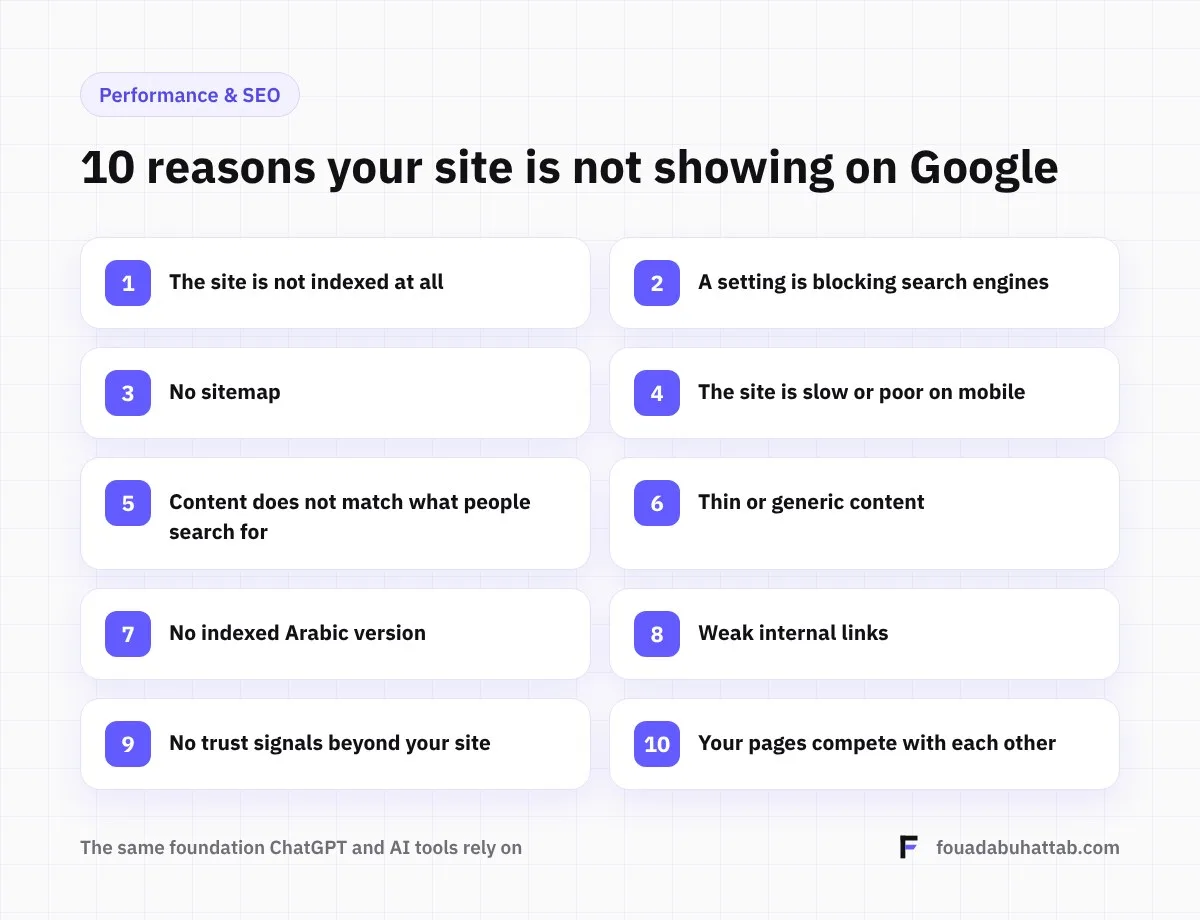
Part one: 10 reasons your site is not showing on Google
1. The site is not indexed at all
Search Google for site:yourdomain.com. If your pages do not appear, the problem is not ranking but indexing. Add your site to Google Search Console and follow the indexing report.
2. A setting is blocking search engines
WordPress has a "Discourage search engines from indexing this site" option that many people forget to turn off after launch, along with noindex tags on some pages.
3. No sitemap
A sitemap points Google to all your important pages. Generate it with an SEO plugin such as Rank Math and submit it in Search Console.
4. The site is slow or poor on mobile
Google evaluates the mobile version first, and a slow site loses to a faster competitor. The fix is covered in 7 steps to speed up your WordPress website.
5. The content does not match what people search for
A service page titled "Our integrated solutions" will not show for someone searching "web design company in Riyadh". Use the words your customers actually type.
6. Thin or generic content
Pages with a few lines give Google no reason to rank them. Add real detail: examples, FAQs and numbers from your work.
7. No indexed Arabic version
If your customers search in Arabic and your site is English only, you are missing half the results. The Arabic version needs separate URLs and hreflang tags.
8. Weak internal links
A page that nothing on your site links to looks unimportant to Google. Link your articles to your service pages and vice versa.
9. No trust signals beyond your site
A complete Google Business Profile, mentions of your company on other trusted sites, and links from clients or partners are all trust signals Google relies on.
10. Your pages compete with each other
If several pages target the same keyword, Google has to choose which to show, and both get weaker. Give each page a different main keyword.
Not sure which of these apply to your site? I check all ten points and rank the fixes by impact. Request an SEO diagnosis
Part two: showing up in ChatGPT, Gemini and AI tools
When someone asks an AI tool, it often searches the web and builds an answer from sources it trusts, citing some of them. This is known as Generative Engine Optimization (GEO). The good news is that most of what helps you on Google helps here too, with a few important additions:
Let AI crawlers in: some security settings or robots.txt files block bots such as GPTBot, ClaudeBot and PerplexityBot, so these tools cannot read your site at all.
Answer directly: AI tools favor paragraphs that answer a clear question in the first sentence: how much does it cost? what is the difference? when should I choose this? FAQs are one of the strongest formats for this.
State specific numbers and facts: content with clear prices, results and comparisons is easier to cite than general statements.
Keep your company details consistent everywhere: the same name, services and location on your site, LinkedIn and Google Business Profile, so these tools understand who you are and what you offer.
Use structured data (Schema): it tells machines who wrote the content, what type of page it is, and what service is offered.
Do not ignore Bing: some AI tools rely on search indexes other than Google's, so add your site to Bing Webmaster Tools.
Frequently asked questions
How long does it take a new site to appear on Google?
Indexing can happen within days, but strong rankings for competitive keywords usually take a few months of consistent content.
Do I need an llms.txt file?
It is a proposed standard that summarizes your site for AI tools, and there is no conclusive evidence of its impact yet. Adding it does no harm, but it does not replace clear, trustworthy content.
Is installing an SEO plugin enough?
A plugin organizes titles and sitemaps, but it does not write content that answers your customers' questions, and it does not build your site's trust from the outside.
Start with a diagnosis
Open Search Console today and go through the ten points one by one. If you would rather have someone handle it, explore my WordPress SEO service or get in touch.